Martin Mars: the 27,000-litre question B.C. still has to answer
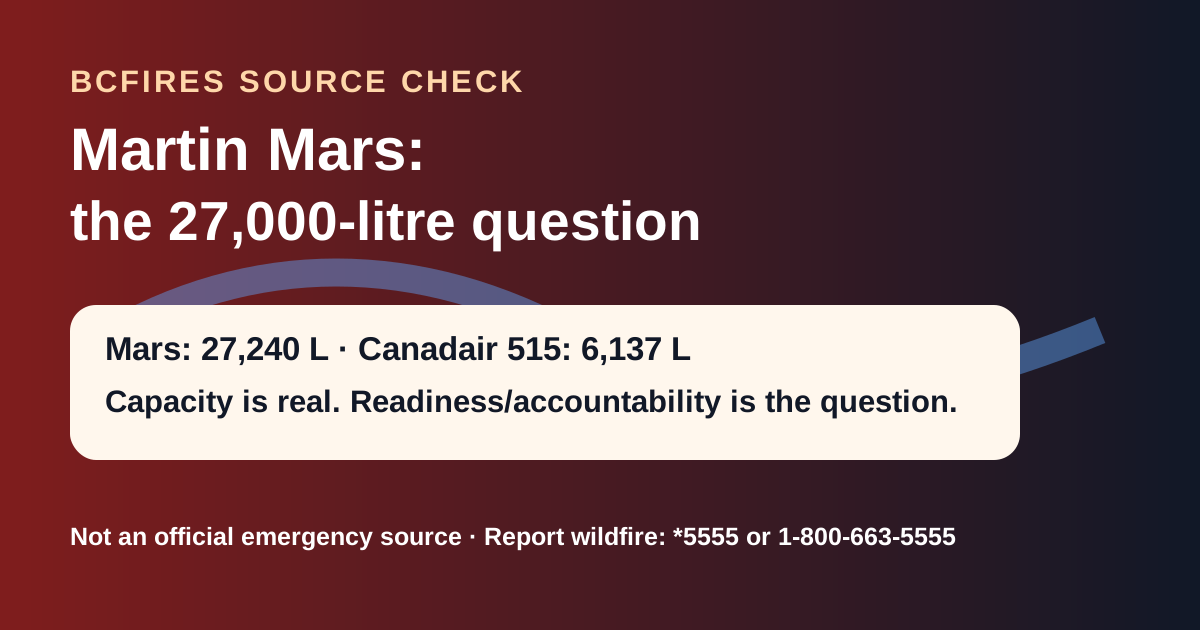
The public anger around the Martin Mars is not imaginary. The aircraft really was in a class of its own for raw water volume: BC Aviation Museum lists a 27,240-litre maximum tank capacity and a 20–30 second pickup time. A Canadair 515-class aircraft carries 6,137 litres — about 22.5% of a Mars load. But raw capacity is not the whole dispatch decision. That is exactly why B.C. should publish the aircraft analysis.
Short verdict
The capacity argument is sourced. The Martin Mars carried roughly 27,000 litres / 7,200 US gallons per drop. The Canadair 515 spec is 6,137 litres / 1,621 US gallons. The Mars load is roughly 4.4 Canadair 515 loads.
The current-status claim needs correction. Hawaii Mars is no longer simply sitting at Sproat Lake/Port Alberni as an active tanker. It made its final flight to the BC Aviation Museum at North Saanich/Victoria in 2024.
The accountability question remains fair. If B.C. chose smaller, more numerous, more flexible aircraft over Mars-scale volume, the public deserves the dispatch doctrine, cost/readiness memo, lake-access analysis and rejected-options file.
Capacity comparison
| Aircraft / figure | Litres | US gallons | Source note |
|---|---|---|---|
| Martin Mars / Hawaii Mars | 27,240 L | 7,200 US gal (rounded source figure) | BC Aviation Museum: max tank capacity 27,240 litres; BCAM/Coulson release says 27,000 L / 7,200 US gal per drop. |
| Canadair 515 | 6,137 L | 1,621 US gal | De Havilland Canadair 515 spec: water tank capacity 6,137 L / 1,621 US gal. |
| User rounded “new bomber” figure | 6,000 L | 1,585 US gal | 6,000 L converts to 1,585.0 US gal; this is a close rounded shorthand for the 515/CL-415 class. |
| Canadair 515 as percent of Mars | 22.53% | 22.51% by US gal | 6,137 / 27,240 = 22.53%; 1,621 / 7,200 = 22.51%. |
| Trips needed to match one Mars load | 4.44 Canadair 515 loads | 4.44 by US gal | 27,240 / 6,137 = 4.44. Using 6,000 L gives 4.54 trips. |
Timeline
- 1940s: Martin JRM Mars built as large U.S. Navy flying boat / transport class; Hawaii Mars later became one of the surviving aircraft.
- 1958–1960s: Surviving fleet sold to B.C. forest-industry consortium and converted into water bombers.
- 1963: Hawaii Mars and Philippine Mars converted for firefighting, per AerialFire history.
- 2007: Coulson purchased the two Mars aircraft, starting its fixed-wing airtanker operations, per BCAM/Coulson release.
- 2013: AerialFire says final U.S. use was the La Brea Fire, after which aircraft returned to Sproat Lake.
- 2015: BCAM/Coulson release says Coulson retired its Mars waterbombers in 2015; Vintage Aviation quotes BCWS saying it had not been used in B.C. since 2015.
- Aug. 11, 2024: Hawaii Mars final flight from Port Alberni/Sproat Lake area to Pat Bay / BC Aviation Museum, escorted by Snowbirds.
- Sept. 28, 2024: BCAM planned official ribbon-cutting/opening for public display.
What about the 2003 Okanagan fire?
The 2003 Okanagan Mountain Park fire is a legitimate historical anchor for this debate: public summaries put it at about 25,912 hectares burned and 239 structures destroyed. The reader claim that citizens “begged” government to use the Mars is plausible as a public-memory claim, but BCFires did not verify that exact wording from a primary source in this pass. We can update if a council record, petition, news archive or BCWS dispatch record is found.
Does water turn to steam before it hits the forest floor?
Some water can evaporate, drift, atomize or be intercepted by canopy before reaching the target, especially with high heat, wind, poor drop height or a bad line. But BCFires found no public BCWS percentage that says how much of a large water drop becomes steam before contact. Aerial drops are best treated as suppression support — cooling, slowing, wetting fuels and buying time for ground crews — not as a standalone cure for a 10,000-hectare fire.
What B.C. should disclose
- The Mars retirement / non-renewal decision memo and any later reassessments.
- Cost per flight hour, maintenance, crew, certification and insurance assumptions used by BCWS or contractors.
- Which lakes and fire zones were considered operationally suitable or unsuitable for Mars-scale flying boats.
- Dispatch doctrine comparing one very-large scoop aircraft to groups of smaller aircraft.
- Water/retardant drop-effectiveness analysis: coverage level, evaporation/drift/canopy loss and whether drop outcomes were audited.
- Current procurement timeline for Canadair 515 / CL-415EAF-class aircraft and what is available this season versus next season.
Claim table
| Claim | Evidence label | Finding |
|---|---|---|
| Martin Mars could carry about 7,200 US gallons / 27,000 litres per drop. | Supported with precision | BCAM/Coulson release says 27,000 L / 7,200 US gal; BCAM specs list 27,240 L tank max capacity. |
| It could pick up water in about 22 seconds. | Supported as a range, not exact 22 every time | BCAM specs list pickup time 20–30 seconds. |
| New Canadair-class amphibious bombers carry only about 6,000 litres / 1,585 gallons. | Mostly supported as shorthand | De Havilland Canadair 515 spec is 6,137 L / 1,621 US gal; 6,000 L is a rounded public shorthand. |
| 6,000 L is only about 22% of a Mars load. | Supported | 6,000 / 27,000 = 22.2%; 6,137 / 27,240 = 22.5%. |
| The Hawaii Mars is still floating in Port Alberni ready to go. | Outdated / corrected | BCAM says the final flight to its forever home at the BC Aviation Museum was Aug. 11, 2024. Earlier it was based at Sproat Lake/Port Alberni. |
| The Mars was retired two years ago. | Needs correction | Museum move/final flight was in 2024; Coulson/BCAM source says Coulson retired its Mars waterbombers in 2015 after earlier firefighting use. |
| It never should have been retired. | Opinion / accountability argument | Capacity supports the public question, but operational readiness, maintenance, crew, certification, safety envelope, water-body access and dispatch doctrine also matter. |
| Water turns to steam before reaching the forest floor. | Real physics concern, no simple public percentage found | Effectiveness depends on drop height, wind, humidity, heat, canopy interception, droplet size and target. We found no BCWS public percentage for evaporation loss. |
| B.C. should explain why Mars-type capability is absent while fires burn. | Accountability question supported | The record supports asking for procurement/dispatch analysis, cost, readiness and rejected-options documents. |