Source-check · military history / wildfire causes · August 14, 2026
Forest Fire as a Military Weapon: what the 1970 report proves — and does not prove
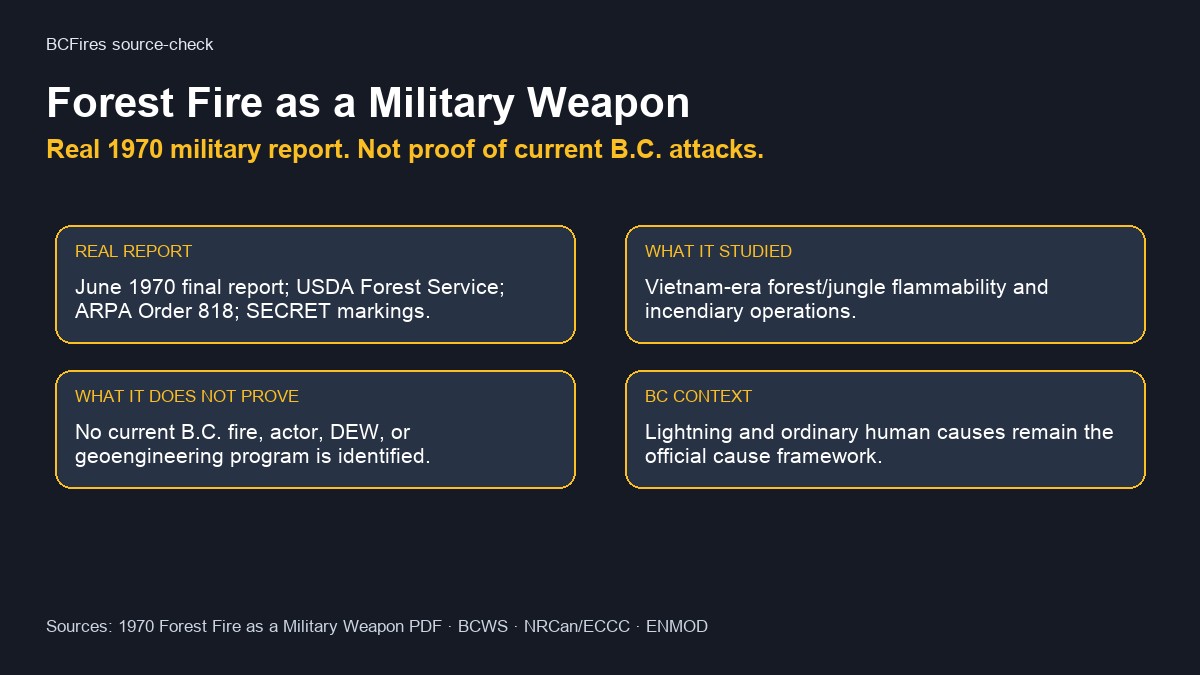
Dane Wigington’s Reel points to a real June 1970 report on forest fire as a military weapon. BCFires retrieved the report and preserved it. The careful finding: the historical military research is real, but it does not prove current B.C. wildfires are military, geoengineering or directed-energy attacks.
Short verdict
- Real report: BCFires retrieved a 175-page PDF titled Forest Fire as a Military Weapon, dated June 1970, with USDA Forest Service authors Craig C. Chandler and Jay R. Bentley and ARPA Order No. 818 sponsorship.
- Real content: The report discusses measuring and modifying forest/jungle flammability, killing shrub vegetation, selecting weather windows, preselected ignition patterns and Vietnam-era incendiary operations including HOT TIP and PINK ROSE.
- Not proven: The report does not prove current B.C. fires are being orchestrated by military forces, geoengineering operations, directed-energy weapons or named local actors.
- BC context: Official cause frameworks still matter: B.C. sources distinguish lightning/natural starts from human-caused starts, and human-caused does not automatically mean arson or sabotage.
The report BCFires retrieved
The PDF cover supplied by the archive says Vietnam War: Forest Fire as a Military Weapon, “a June 1970 report of study commissioned by the Department of Defense.” The extracted original title page says FOREST FIRE AS A MILITARY WEAPON, final report, June 1970, U.S. Department of Agriculture — Forest Service, sponsored by Advanced Research Projects Agency / Overseas Defense Research, ARPA Order No. 818. Extracted pages show SECRET and “Not automatically declassified” markings.
BCFires preserved the PDF in the source package: download the preserved report PDF. SHA-256: feef9f3c107c5f92b1f8a324c3ae3a8964a68bc72020f26a0059ab1f91664f31.
What the report says
The report says that in 1965 the Joint Chiefs of Staff requested research on the feasibility of measuring forest and jungle flammability, modifying flammability so vegetation would support combustion, and developing measures to destroy large forest or jungle areas by fire. It says the research was conducted by the Forest Service under ARPA sponsorship.
The report summary says forest flammability depends on dead vegetation near the ground, moisture content and weather, and that flammability can be increased by killing shrub vegetation, choosing optimum weather conditions and igniting fires in a preselected pattern. It also notes that crown fires are not always achievable and that fire as a weapon is highly weather-dependent.
Claim table
| Claim | Finding |
|---|---|
| The report exists. | Supported. A 175-page PDF copy was retrieved and archived. |
| It was U.S. military-linked research. | Supported. The report refers to Joint Chiefs of Staff request, ARPA sponsorship and USDA Forest Service research. |
| It studied making forests/jungles burn for military purposes. | Supported. The report discusses flammability modification, weather windows and ignition patterns. |
| It proves B.C. fires are military attacks. | Not supported. The report is Vietnam-era and does not identify current B.C. events or actors. |
| It proves geoengineering/climate intervention prepared forests for current fires. | Not proven. The Reel asks this question; the report does not establish the modern claim. |
| Human-caused B.C. fires equal arson/sabotage. | False. Human-caused includes many categories; official cause investigations are needed before assigning blame. |
Records still wanted
- Official DTIC or National Archives bibliographic record for AD0509724 / the June 1970 report.
- Declassification/release history for the original classified report.
- Any Canadian/B.C. official record assessing hostile wildfire use, arson terrorism, environmental modification or critical-infrastructure sabotage risks.
- For any specific current wildfire: BCWS cause investigation, police release, court record or credible reporting before making an intentional-cause claim.